

November 18, 2026
By Lily Padula
Click here to read the full report
Executive Summary
Illinois’ income tax structure remains a recurring issue in state fiscal policy as ongoing structural fiscal pressures and growing demands for investment in education, public transit, pensions, and other public services continue to prompt debate over the state's revenue system. Illinois relies heavily on individual and corporate income taxes and sales taxes to support ongoing operations, but several features of its tax structure—including a constitutionally required flat income tax, a relatively narrow sales tax base, and reliance on excise taxes—raise questions about the adequacy, sustainability, and distribution of State revenues. Proposals to adopt a graduated income tax or impose additional taxes on high-income earners, often referred to as “millionaire’s taxes,” have emerged periodically in Illinois' fiscal policy debates in recent years.
As state policymakers weigh revenue options, this issue brief lays out several of the approaches Illinois could take to adjusting its income tax structure. This issue brief does not endorse or recommend a specific proposal. Rather, it explains Illinois’ current income tax system and identifies potential pathways for reform. Within each of the pathways presented, the report outlines illustrative revenue scenarios and examines the fiscal, economic, and distributional tradeoffs associated with different policy design choices.
Illinois currently applies a flat individual income tax rate of 4.95% to taxable income. Because a flat rate is required by the Illinois Constitution, some changes that preserve a single rate—such as adjustments to rates, deductions, exemptions, or credits—could generally be made through a change to state statute. A graduated income tax or high-income surcharge, however, would require constitutional approval and therefore a change to the Illinois Constitution. Voters rejected a 2020 constitutional amendment that would have allowed Illinois to replace its flat income tax with a graduated rate structure, but the concept of a graduated tax or high-income surcharge remains a key proposal in revenue debates, making an understanding of the available policy options and their implications critical to discussions about Illinois’ fiscal challenges.
The report examines three broad pathways for modifying the individual income tax:
- Modifications within the existing flat-tax structure: Adjusting the uniform rate, increasing exemptions or deduction, or expanding the tax base by taxing retirement income. Larger exemptions or deductions could provide lower-income tax relief while retaining a single rate, although higher rates would be necessary to offset the resulting reduction in taxable income or generate additional revenue.
- A high-income surcharge: Imposing an additional tax on income above a specified threshold while retaining the existing flat tax as the underlying structure. This approach would concentrate additional tax liability on higher-income taxpayers without directly increasing rates on income below the threshold.
- Graduated income tax structures: Establishing multiple marginal rates and income brackets to distribute tax liability differently across income levels. Depending on their design, these structures could provide tax relief to lower- and middle- income households while generating additional revenue from higher-income taxpayers. The report examines the 2020 graduated income tax proposal and three alternative illustrative models (Model A, B, and C).
For each approach, the report outlines how each structure would work, how much revenue the tax could potentially generate, and the policy considerations and tradeoffs associated with each option.
For each approach, the report outlines how each structure would work, how much revenue the tax could potentially generate, and the policy considerations and tradeoffs associated with each option.
Revenue Estimates:
The scenarios demonstrate how different tax structures and policy design choices affect potential revenue generation. Gross new revenue represents the additional revenue a tax structure could generate assuming no change in taxpayer behavior, while net new revenue accounts for potential changes in reported taxable income in response to changes in tax rates.
Modifications within the existing flat-tax structure. Policymakers could increase the existing flat rate, pair a higher rate with larger deductions to redistribute tax liability or expand the income tax base.
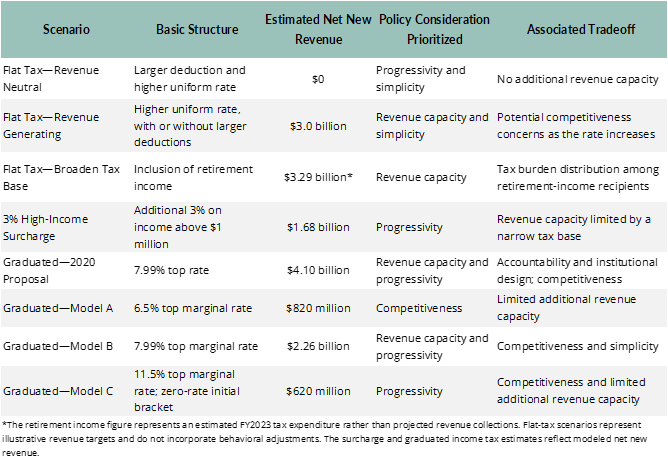
- With no changes to the existing taxable income base, increasing the flat rate from 4.95% to approximately 5.58% could generate $3 billion in additional annual revenue before accounting for potential changes in taxpayer behavior.
- Under scenarios that pair larger deductions with a higher flat rate, the rate required to maintain existing revenue ranges from 5.25% to 8.29%, while the rate required to generate approximately $3 billion in additional annual revenue ranges from 5.92% to 9.35%.
- Taxing retirement income represents another potential source of revenue. The Illinois Comptroller estimated that the retirement income and Social Security subtraction represented approximately $3.29 billion in foregone revenue in FY2023, although this amount does not necessarily represent the revenue that would be collected if the exclusion were eliminated.
High-income surcharge. A 3% surcharge on income above $1 million, in addition to the existing 4.95% flat rate, is estimated to generate approximately $1.68 billion in net new annual revenue, affecting roughly 30,000 tax returns. Unlike broader changes to the income tax structure, the surcharge would directly increase tax liability only for taxpayers with incomes exceeding the specified threshold.
Graduated income tax structures. The graduated income tax scenarios generate a range of estimated revenues depending on the income brackets and marginal rates selected.
- The 2020 proposal generates approximately $4.10 billion in net new revenue, the most of the graduated income tax scenarios examined, with a top rate of 7.99%.
- Model A prioritizes comparatively moderate marginal rates, limiting the top rate to 6.5%, and generates approximately $820 million in net new revenue.
- Model B seeks to balance additional revenue generation with more moderate rate increases, establishing a top marginal rate of 7.99% and generating approximately $2.26 billion in net new revenue.
- Model C places the greatest emphasis on progressivity, pairing an 11.5% top marginal rate with a 0% rate on the first $15,000 of income for single filers and $30,000 for joint filers. The model generates approximately $620 million in net new revenue.
These estimates are illustrative rather than official revenue forecasts. Because individual tax return data are not available, the analysis relies on assumptions about how income is distributed within the income ranges published by the Illinois Department of Revenue, the number of tax returns and taxpayers’ filing statuses. The net revenue estimates for the high-income surcharge and graduated income tax scenarios also account for the possibility that taxpayers may change their behavior in response to changes in tax rates. An additional adjustment is applied to the 2020 proposal to align its revenue estimate with the Pritzker administration’s original projection, adjusted for growth in the Illinois income base. Actual revenue collections under these scenarios could differ materially from the estimates.
Policy Considerations and Tradeoffs:
The design of an individual income tax involves considerations that extend beyond how much revenue it could generate. This report identifies five policy considerations relevant to evaluating alternative income tax structures:
- Tax burden distribution and progressivity: How tax liability is distributed among taxpayers at different income levels.
- Competitiveness: How a tax structure may influence economic decisions and Illinois’ position relative to other states.
- Simplicity: How easily taxpayers can understand and comply with the tax structure and the State can administer it.
- Revenue capacity: The ability of a tax structure to generate sufficient and sustainable revenue to support the State’s fiscal obligations.
- Accountability and institutional design: How decisions about tax rates and structures are made and how future changes could be implemented.
Each of the three pathways involves different tradeoffs. A flat-tax structure offers relative simplicity, and adjustments could be implemented without a constitutional amendment. However, pairing larger deductions with additional revenue generation would require increasingly high uniform rates. A high-income surcharge would concentrate additional tax liability on a relatively small group of taxpayers but would rely on a narrower and potentially more volatile tax base. A graduated income tax would provide greater flexibility to redistribute tax liability across income levels but would introduce additional complexity and require changes to the State’s constitutional framework.
The graduated income tax scenarios also demonstrate that a higher top marginal rate does not necessarily generate more revenue. Model C provides the greatest relative relief at lower income levels and the largest shift in tax liability toward upper-income taxpayers. However, because its zero-rate bracket applies to every taxpayer’s first dollars of income, it generates the least estimated revenue among the graduated scenarios despite having the highest top marginal rate. Its 11.5% top rate may also raise concerns about Illinois’ competitiveness and potential taxpayer responses. By comparison, the 2020 proposal and Model B generate more revenue with top rates of 7.99%, while Model A maintains a comparatively moderate top rate but generates less additional revenue. These differences illustrate the importance of considering the entire tax structure rather than the top marginal rate alone.
Changes to individual income tax rates could also affect businesses organized as pass-through entities, including S corporations and partnerships, because their profits are generally reported on owners’ individual income tax returns. The direct impact on business owners and other taxpayers would depend on their total taxable income and the rates and thresholds established under each proposal. Although broader economic effects are possible, their magnitude and distribution are uncertain and are not estimated in this analysis. The overall impact would also depend on how additional revenue is used.
Illinois’ current 4.95% flat rate ranks 24th nationally, according to the Tax Foundation. Illinois is one of 15 states that apply a single-rate individual income tax, and its rate is higher than those of several neighboring flat-tax states but below the top marginal rates in many graduated income tax states. Changes to Illinois’ income tax structure could therefore affect not only how tax liability is distributed within the State but also its relative position among states.
There is no single income tax structure that simultaneously maximizes revenue generation, progressivity, simplicity and competitiveness. The scenarios presented in this report are intended to serve as a starting point for understanding the options available to Illinois policymakers, rather than an exhaustive list of potential income tax structures or an endorsement of a particular approach. Policymakers could combine different rates, brackets, exemptions and other design features in numerous ways depending on their objectives. The report seeks to provide a framework for evaluating these choices and understanding how the individual income tax fits within Illinois’ broader fiscal system, including other revenue sources, spending priorities and long-term fiscal obligations.
Illinois Income Tax Revenue Simulator
As Illinois debates various income tax proposals, including a millionaires’ tax, the Civic Federation prepared this report to provide policymakers with a resource to help inform those conversations. The Civic Federation has also created an Illinois Income Tax Revenue Simulator, which lets you design alternative tax structures by adjusting income brackets, rates, exemptions and behavioral responses. The simulator allows users to see how different structures would affect households at varying income levels and estimates how much revenue each structure would raise compared with Illinois’ current 4.95% flat tax.
Click here to read the full report