
July 09, 2026
Paula R. Worthington
Overview
The USDA’s Supplemental Nutrition Assistance Program (SNAP) is an essential component of the social safety net. Last year’s H.R. 1 legislation made significant changes to the program, including new state cost-sharing requirements tied to payment error rates. Data released by the U.S. Department of Agriculture (USDA) on June 24, 2026, indicate that Illinois’ SNAP payment error rate (PER) remains elevated, exposing the State to the possibility of significant future fiscal pressure.
Key findings include:
- Illinois’ payment error rate rose from 11.56% in federal FY2024 to 14.67% in federal FY2025.
- At this rate, Illinois would fall into the highest cost-sharing category and would be required to cover 15% of SNAP benefits paid to Illinois enrollees beginning in October 2027, the start of federal FY2028.1
- At the current Illinois SNAP enrollment level of 1.565 million individuals as of May 2026, and with average monthly benefits of $195 per person, this 15% cost share implies a potential annual State cost of nearly $550 million. That amount is significant, though lower than earlier estimates of over $700 million because SNAP enrollment has declined considerably since January 2025.
Significant declines in SNAP program enrollment offer a mixed blessing to the State: benefits costs will decline alongside enrollments, limiting the fiscal “hit” to the State from new benefits cost-sharing provisions. But disenrolled individuals may face increased food insecurity and financial stress, putting more pressure on others to fill the gaps. Further, linking payment error rates to cost-sharing levels forces states - including Illinois - to improve program administration while not turning away eligible applicants from the program, all while facing less federal support for covering administrative costs.
In previous work, we have examined the federal government’s historical role in the program and explored the potential enrollment and cost impacts of H.R. 1 in Illinois. In this post, we explore the most recent numbers in greater detail.
Recap of H.R. 1’s Policy Changes
H.R. 1 (P.L. 119-21) made significant changes to SNAP eligibility rules and funding responsibilities. Key provisions included:
- Imposing work requirements on the near elderly (ages 55-64) and parents of older children (ages 14-17). Effective February 1, 2026, nonelderly, nondisabled adults who are not custodians of younger children may receive benefits for only 3 months (of every three years) if they fail to meet an 80-hour per month work requirement.
- Increasing the state share of SNAP administrative expenses from 50% to 75%, as of October 2026.
- Implementing benefits cost-sharing for the first time beginning October 2027, with higher cost shares imposed on states with higher payment error rates (PERs). States with PERs below 6% will have no cost sharing; those with PERs between 6% and 8% will face a cost share of 5%; those with PERs between 8% and 10% will face a cost share of 10%; and those with PERs above 10% will face the highest cost share of 15%.
Early estimates of effects on Illinois pointed to significant impacts of these changes: in February 2026, IDHS estimated up to 400,000 individuals were at risk of losing eligibility based on the new work requirements, with an updated estimate of approximately 150,000 households at risk by late spring. Estimated cost impacts were also significant: increased administrative cost-sharing would cost Illinois up to $80 million annually, and benefit cost sharing, based on Illinois’ 2024 PER rate of 11.56% and then-current enrollment levels, was estimated to cost the State about $700 million annually.
Illinois SNAP Enrollments
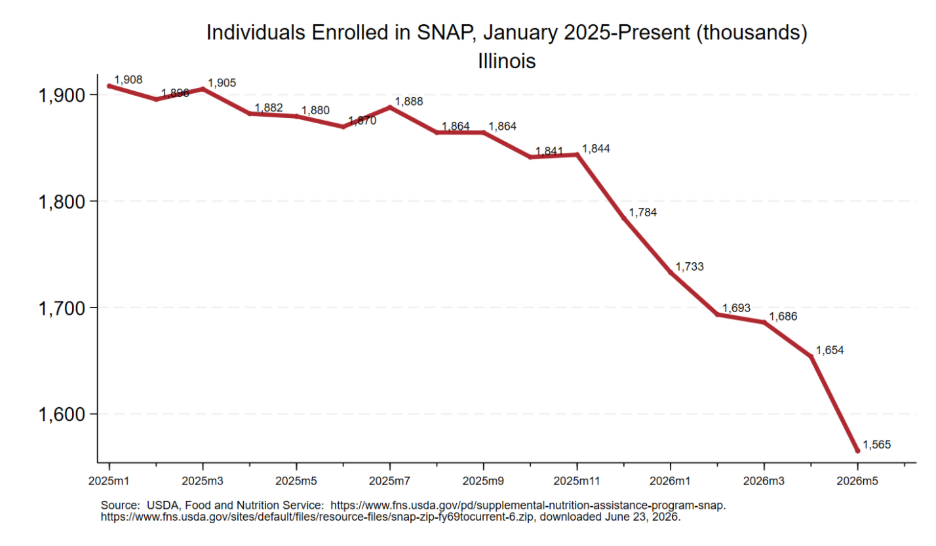
Perhaps unsurprisingly, USDA data through March 2026, supplemented with Illinois Department of Human Services (IDHS) data for April and May of this year, show significant enrollment declines in Illinois. After fluctuating around or just under 2 million individuals since the pandemic, enrollment has fallen more quickly over the last six months. In fact, nearly 90,000 individuals left the SNAP rolls between April and May 2026, the largest monthly decline since September 2023. The timing of this drop aligns with the February 1 effective date discussed earlier, as affected individuals can receive benefits for only three months if they do not meet work requirements.
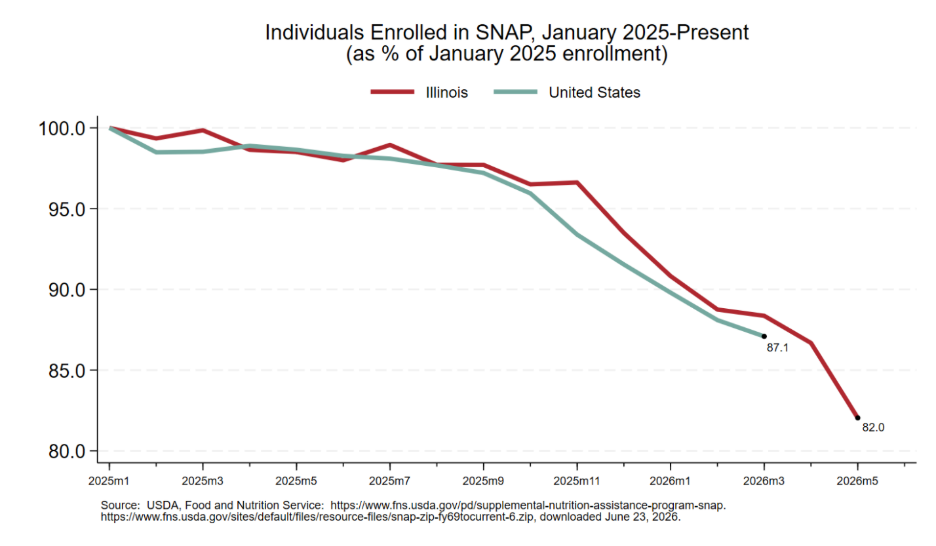
Illinois SNAP enrollment totaled 1.565 million individuals in May 2026, 343,000 (18%) below its January 2025 level. Illinois’ trend is similar to the national pattern, as U.S. enrollment has fallen from 42.8 million to 37.3 million - a decrease of 11.6% over the January 2025 through March 2026 period.
Linking these declines in enrollment to specific factors - in the US overall or in Illinois in particular - is difficult, as detailed data on enrollees, their categories, and their reasons for disenrollment are not systematically available. The Center for Budget and Policy Priorities (CBPP) notes that enrollment decreases to date surpass the CBO’s prior estimates for the country overall and further speculates that the looming shift in benefit cost-sharing from the federal government to the states has prompted some states to “erect barriers to people’s SNAP participation, such as requiring more paperwork and imposing other requirements…” In other words, states are anticipating the October 2027 effective date of cost-sharing by making it more difficult to enroll and stay enrolled. The CBPP also argues that underlying food assistance needs have not decreased and that, at least so far, work requirements and/or limitations on immigrant eligibility cannot explain much of the decreased enrollments. Other observers note that the rolls were still swollen from pandemic-era needs and policies and were somewhat “due” for decreases, with limited time so far to see impacts of H.R. 1.
Payment Error Rates
Payment error rates (PER) are not indicators of fraud, but they are commonly understood as one measure of how accurately SNAP benefits are administered. Payment errors may result in either overpayments or underpayments, reflecting how applicants and program administrators navigate a complex process.2 A state’s PER is the sum of its overpayment and underpayment rates.
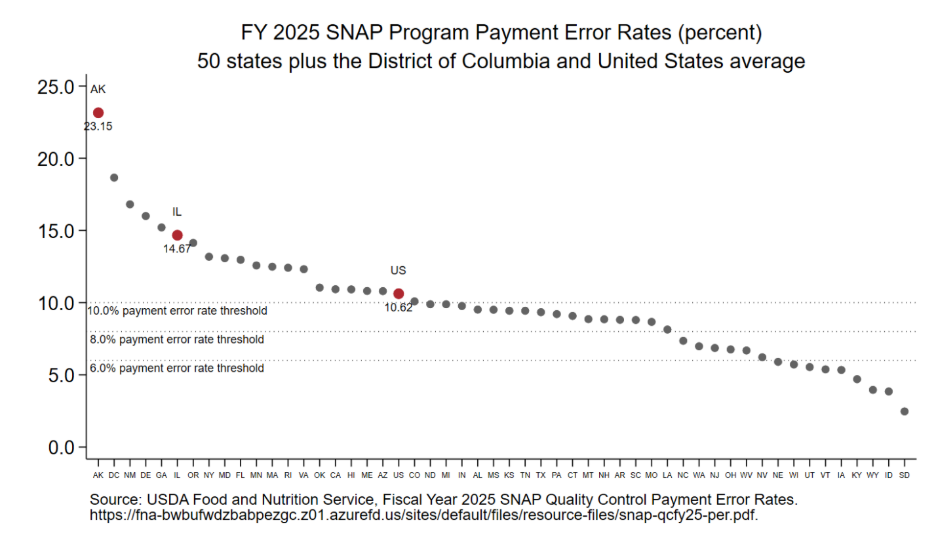
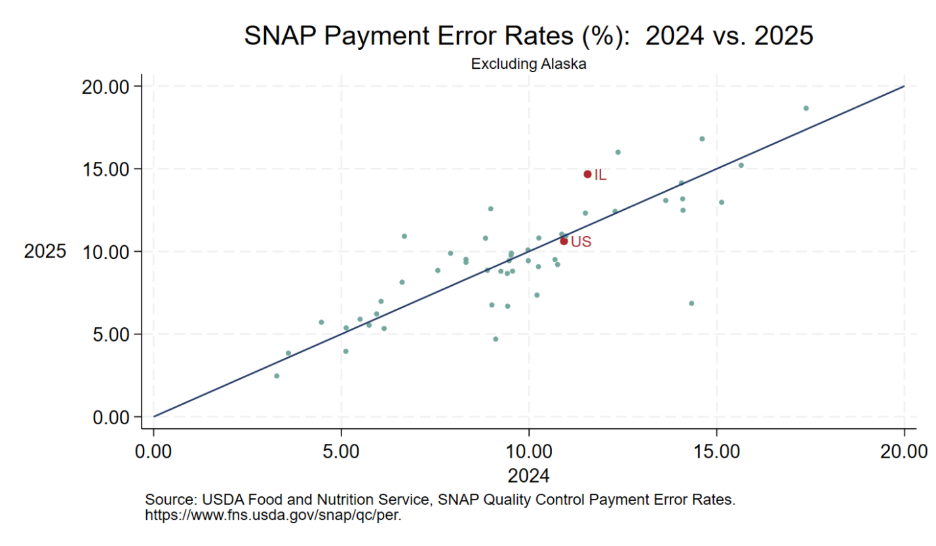
Nationally, the SNAP payment error rate fell slightly, from 10.93% to 10.62% in federal FY 2025. Illinois moved in the opposite direction. The State’s payment error rate (PER) rose over 3 percentage points, from 11.56% to 14.67%, giving Illinois the 6th highest payment error rate in the country.
PERs decreased in 2025 in some states while increasing in others, like Illinois. The graph below compares 2024 PERs against 2025 PERs by state; states above the blue line saw increased PERs, while those below the line showed improvement. Illinois was not the only state whose error rate increased, even though for the country as a whole, the error rate changed only slightly between 2024 and 2025.
Discussion
Illinois’s 2025 payment error rate still leaves it in the highest cost share category. While declining enrollments will mean direct fiscal impacts are lower than previously estimated, such impacts are still significant, even if delayed beyond the original October 2027 start date. We estimate that at current enrollments (May 2026), the State would in principle be on the hook for nearly $550 million annually.3 For every 10,000 person decline in enrollments, the State’s estimated fiscal impact falls by $3.5 million.
As discussed elsewhere, these enrollment declines may lead to increased food insecurity and financial stress, putting pressure on other aspects of the social safety net. More generally, these dramatic changes in eligibility and funding the SNAP program may make it a less robust “stabilizer” program during economic recessions in the future - meaning it will offer less, not more, assistance when economic conditions are poor.4
To date, the State of Illinois has responded in multiple ways to these developments:
- IDHS has increased investments in technology to assist with data validation, hired additional caseworkers, changed verification and documentation requirements, and partnered with multiple agencies and nonprofits to support Illinoisans navigating the new system.
- In its recently approved FY 2027 budget, the State allocated $70 million towards its new Families Receiving Emergency Support for Hunger (FRESH) program. The program is intended to provide one-time emergency payments of $400 to individuals disenrolled due to the imposition of work requirements.5 At average monthly SNAP benefit levels of $195 per person, FRESH payments would be the equivalent of just over two months of benefits for each individual recipient.
Together, declining enrollments and looming loss of federal government support create several overlapping challenges for the State. Illinois must improve SNAP program administration - decrease its payment error rate - while also absorbing increased administrative cost-sharing, implementing work requirement procedures, and addressing rising food and nutritional needs of disenrolled individuals and families. Extending and deepening the “all hands on deck” approach outlined by IDHS in October 2025 will require engagement from all stakeholders - State officials and agencies, local government and nonprofit partners, and indeed all Illinoisans to meet these challenges. The Civic Federation will continue to monitor the State’s efforts to improve accuracy of SNAP administration while maintaining access to this crucial social safety net program.
References
1 H.R. 1 includes provisions that delay the impact on Illinois: “If in FY2025 a state has a PER above 13.32 percent, it is exempt from paying any portion of SNAP benefits until FY2029, and if its FY2026 PER is above 13.32 percent, it is exempt until FY2030.” Illinois is one of 7 jurisdictions (including Washington, DC) affected by this provision.
2 It is worth noting that increased program complexity (for instance, as arising from implementation of H.R. 1’s new provisions) is associated with increased PERs and that “wrongly rejecting an eligible applicant is not considered an error.”
3 Again, Illinois is one of 7 jurisdictions whose 2025 error rates were so high that they will receive a one-year reprieve, delaying their cost-share requirements until federal FY 2029, or October 2028.
4 Bauer and Schanzenbach write: “Up until now, SNAP has provided much-needed relief to families when they fall on hard times. And, up until now, SNAP benefits have served as a crucial economic stimulus because when the economy turns down and more people lose jobs and income, more households have become eligible for the program and participants have quickly spent the benefits in their local economies…Each of OBBBA’s policy changes to SNAP, however, weakens and undermines the program’s ability to alleviate hardship for families during downturns and diminishes SNAP’s vital contribution to stabilizing demand.”
5 Some news reports mention “families”, while others mention “individuals.” Forthcoming administrative rules will clarify these details.